
Through a combination of local manufacture and imported CBU models, the company makes and sells four SUVs, one hatchback, and one sedan.

Cars and two-wheelers attract 28% GST and a cess in the range of 3-22%, taking the effective tax rate to up to 50%.

The models from Hyundai and Maruti, which might go on sale in October 2018 and February 2019, respectively, are set to revive a segment that had lost sheen to the compact SUV segment, lately

Ride-hailing firms claim penetration is still low and there is a huge upside to grow the market and make owning a car pass.

Chinese automakers Great Wall Motors, FAW Haima Automobile, and Changan Automobile, after dithering about entering India for some years, have been encouraged by the robust sales performance of the late entrants Kia Motors and MG Motors even in a slowing market.

Time was when you turned on your car's ignition, all that happened was that the mechanical system fired up your engine and made it run. Today, the moment you do so, your stereo system probably lights up, connects to the Bluetooth on your smartphone, and lets you make calls through an audio assistant or play music from your phone, which you can hear on the car's speakers. All these smart features in a car are powered by semiconductors, or chips, as they are commonly called.

With the Thar, M&M has come full circle. In a market where every other vehicle has an SUV tag, the company plans to stick to its core competence of making rugged, true-blue, all-terrain SUVs, and marks a fresh beginning for the 75-year-old firm that enjoyed an indomitable position in the SUV segment till 2012, reports Shally Seth Mohile.

Mercedes-Benz India, BMW India and Audi India have lined up over 50 new model launches as they seek to recoup previous year's loss in volumes, reports Shally Seth Mohile.

Audi's strategy seems to point to pushing technology to directly connect with consumers using digital platforms and marketing to synchromesh into one seamless experience, says Pavan Lall.

India's growth presents a win-win partnership for the country and the US, and American companies have a great opportunity to contribute to that, Modi told the CEOs.

The MG Motor India management is focused on scaling up and launching smaller cars to play the long game in the country, says Pavan Lall.

Recently, Suzuki Motor Corp (SMC) in an investor presentation expressed strong intent to enter the electric vehicle (EV) space. This is part of a larger strategy the Hamamatsu-based firm has drawn up in developing electrification of technologies as it seeks to achieve carbon neutrality. The significance of this presentation is that it marked the first time that the Japanese carmaker spelt out its EV strategy with well-defined timelines. SMC plans to develop electrification technologies by 2025, fully implement them in products from the same year, and make a full-scale quantitative increase from 2030.
'It says, we are not just an overseas player -- we are Kia India and here for good'

Maruti is not an online outlier, of course; other heavyweights have rolled out similar services. But as an analyst pointed out, Maruti's all-India roll-out has significant impact given that it accounts for over half of all cars sold, reports, reports Pavan Lall.

India wasn't applying widespread crash testing like foreign countries do, so manufacturers didn't see the need for an investment focus on safety. Customers rarely walked into showrooms asking for the safest car. They wanted the cheapest or the most fuel-efficient or the best-looking car.
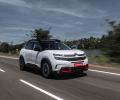
Making a debut in India with an SUV, Citroen's products in the next couple of years will clearly chart and define its destiny in what has become both a vibrant but also a daunting market for foreign entrants, says Pavan Lall.

M&M will close down GenZe, an e-scooter business in California, because it is unlikely it would stand on its own feet, and is ahead of its time.

What will it take for Tesla to plug and play in India? Sector pundits say it's a mix of strategy, getting the price right, timing, the right talent, and above all, patience.

For Hero MotoCorp, India's largest two-wheeler company, it's a calculated gambit to revive Harley-Davidson whose ride in India has been anything but easy since it got here.When automotive firms embark on alliances, it's a roll of the dice on how such marriages will play out.

Tata Motors, India's third largest passenger vehicle maker, took pole position in the competitive sport utility vehicle (SUV) market in October, reveals the data from industry sources. Riding high on the Punch - the sub-compact SUV offering launched on October 18 - the Tata group flagship sold a record 23,381 units in October, higher than 20,022 units sold by archrival Mahindra & Mahindra, 18,538 units sold by Hyundai Motor India, and 15,931 units sold by Kia Motors India. Utility vehicles - that include SUVs and multipurpose vehicles - accounted for almost one in every two passenger vehicles sold in India in the first seven months of the current financial year, according to the Society of Indian Automobile Manufacturers.

The mismatch between PMI and core sector could also be due to the fact that while core sector is calculated year-on-year, PMI is calculated month-on-month.

With only a handful of models by a few manufacturers including Tata Nexon, MG ZS, Hyundai Kona, among others, the segment has remained under tapped.

First-time buyers of cars and sport utility vehicles (SUVs) have made a comeback, shows last year's data from top passenger vehicle (PV) makers. If the trend persists, it may move the needle on the overall car penetration ratio. India's car penetration ratio is 32 per 1,000 people - one of the lowest, compared to mature car markets like the US and Europe.

For automakers, the festive season is about raking it in through ramped up sales and attractive consumer offers. However, despite the robust demand, what may spoil the party this year is a global shortage of semiconductors.

Despite the romance around the car and its early models, Fiat in India will also be remembered as a brand that frittered away the first mover advantage, says Shally Seth Mohile.

The move is prompted by the disruption in the car usage pattern caused by the app-based ride-hailing companies such Ola and Uber
